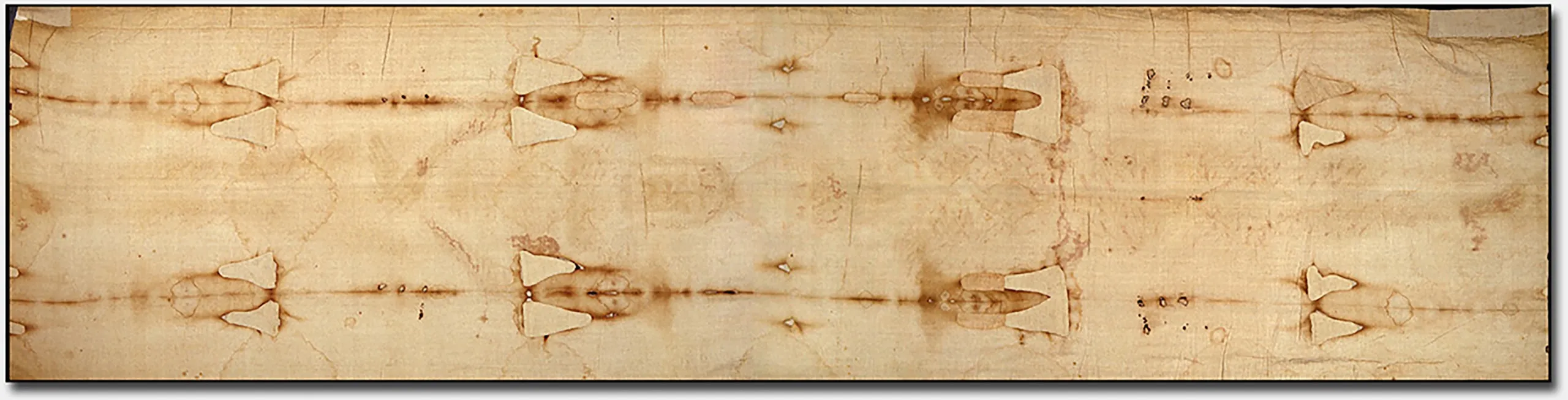
For centuries, a single 14-foot strip of linen housed in the Cathedral of St. John the Baptist in Turin, Italy, has captivated the world. It has survived fires, intense scientific scrutiny, and endless historical debates.
To the naked eye, the Shroud of Turin displays a faint, sepia-toned imprint of a scourged, crucified man. But when the Catholic Church and popes like St. John Paul II and Pope Francis look upon it, they use a profoundly specific word to describe it. They call it a “Mirror of the Gospel.”
When we look into a physical mirror, we see a reflection of reality. When we look into the Shroud of Turin, we see a physical reflection of the Passion of Jesus Christ. Here is how this ancient cloth mirrors the biblical narrative, stymies modern science, and ultimately asks a mirroring question about our own faith.
1. Mirroring the Gospel: The Anatomy of the Passion
The most striking aspect of the Shroud is how its wounds perfectly align with the New Testament accounts of Jesus’s crucifixion. It is not just a general depiction of death. It is a forensic duplicate of the Gospels written in blood.
The Scourging: The Shroud reveals over 100 whip marks across the man’s back and legs, matching the brutal Roman flagrum used on Jesus before his walk to Calvary.
The Crown of Thorns: Traditional artwork often depicts a neat ring of thorns. The Shroud mirrors a more ruthless reality: puncture wounds covering the entire scalp, indicating a thick cap of thorns forced onto his head.
The Pierced Side: The cloth features a distinct bloodstain on the right side of the chest, mirroring the moment a Roman soldier pierced Jesus’s side with a spear, bringing forth a sudden flow of blood and water.
But one of the soldiers with a spear pierced his side, and forthwith came there out blood and water.
John 19:34
Every laceration, every bruise on the shoulders consistent with carrying a heavy crossbeam, and every nail wound in the wrists and feet directly reflects the biblical manuscript.
2. The Photographic Mirror: Hidden in Plain Sight
For hundreds of years, skeptics dismissed the Shroud as a crude medieval painting. But in 1898, an Italian photographer named Secondo Pia took the very first photograph of the cloth, and what happened in his darkroom shocked the scientific community.
As the photographic negative developed, Pia realized that the faint, blurry image on the cloth was actually a perfect photographic negative itself. When inverted by the camera, it revealed a stunningly detailed, anatomically flawless, three-dimensional positive image of a man with a majestic, haunting countenance.
How could a medieval artist paint a perfect photographic negative centuries before the invention of photography? The short answer is they could not. The image was not painted on. It was imprinted into the very topmost fibers of the linen.
3. The Science of the “Flash”: Mirroring the Resurrection
Modern science has tried desperately to debunk or explain the Shroud. While a controversial 1988 carbon-dating test pointed to a medieval origin, subsequent researchers discovered those samples were taken from a contaminated, re-woven corner used to repair the cloth after a 1532 fire.
When international physicists and forensic teams analyzed the image itself, they uncovered properties that defy natural explanation:
- The image does not penetrate the cloth. It sits entirely on the ultra-thin, outermost surface of the linen fibrils.
- There are no pigments, chemicals, or vapors binding the image to the cloth.
- Aerospace scientists using NASA VP-8 Image Analyzers discovered that the Shroud contains encoded 3D topographical data, something standard 2D photographs or paintings cannot replicate.
Many modern researchers hypothesize that the image could only have been formed by a massive, instantaneous burst of vacuum ultraviolet radiation: a flash of pure light energy released without heat. To the believer, this scientific mystery perfectly mirrors the precise moment of the Resurrection, where light conquered the darkness of the tomb.
4. The Ultimate Mirror: What Do You See?
When St. John Paul II visited the Shroud, he noted that it invites us to contemplate human suffering and God’s ultimate act of love. It acts as a mirror to our own hearts.
The Shroud does not force belief. The Catholic Church has wisely stopped short of formally declaring its absolute authenticity, leaving it instead as an “icon of love” for the faithful to examine. It sits at the perfect intersection of faith and reason.
If the Shroud is a mirror, it forces us to look past the linen and look at our own lives. Do we see a historical forgery, or do we see the physical receipt of our redemption?
The Shroud of Turin remains the most studied artifact in human history, and new scientific discoveries continue to emerge every year. The Mirror of Jesus Christ lays out the full forensic case, footnote by footnote, with the photographs and analysis side by side, so you can weigh the evidence and decide for yourself.