
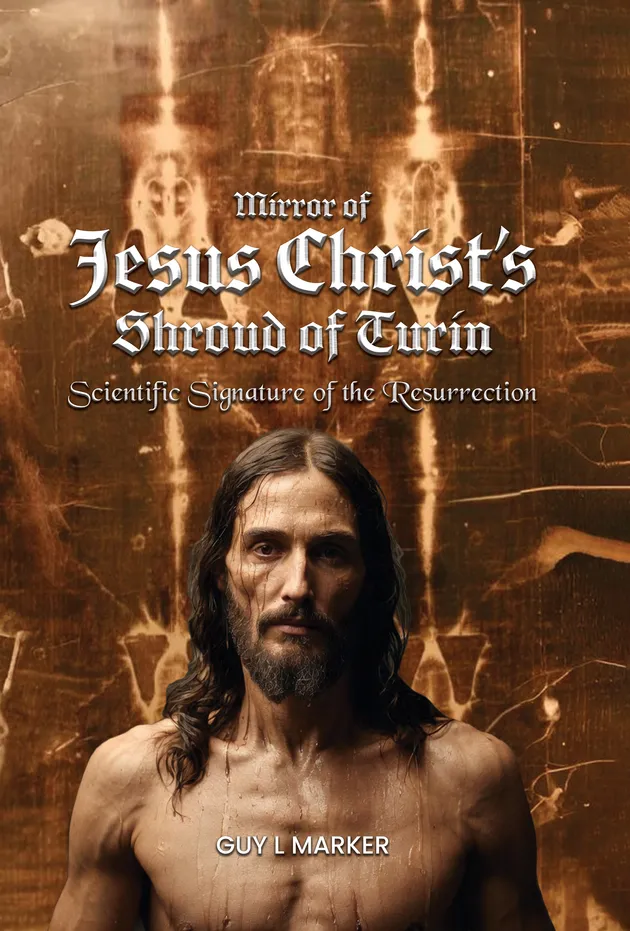
A Shroud of Turin Book Unlike Any Other
Most books about the Shroud of Turin approach the subject through devotion or speculation. This one takes a forensic path. Guy L. Marker's research uses 34-billion-watt VUV radiation analysis and WAXS X-ray dating to examine what he calls the "State-Change Bridge" of the Resurrection. Anatomical analysis traces the nail wound through the Space of Destot in the wrist, the only point capable of supporting the body's weight under crucifixion. Every claim is documented across 2,706 footnotes, creating a complete research trail that readers can verify independently.
Is the Shroud of Turin real? That question drives the entire investigation. The book confronts the shroud of Turin scientific evidence head-on, including the controversial 1988 carbon dating results and why modern researchers believe the tested sample was contaminated. The forensic triad of bilirubin, ferritin, and creatinine in the blood points to extreme physiological stress consistent with crucifixion, and travertine aragonite limestone dust on the cloth matches the geology near Jerusalem's Damascus Gate. New imaging techniques and X-ray crystallography data are presented alongside historical chain-of-custody documentation spanning nearly two thousand years.
The 91 color images in this book present the shroud of Turin face of Jesus through visual reconstructions built from the Shroud's negative image using modern imaging technology and AI-assisted analysis. The image follows the Inverse Square Law: pixel intensity correlates precisely with cloth-to-body distance, encoding three-dimensional depth that no medieval painter could replicate. These are not traditional artistic interpretations. They are derived directly from the facial proportions and wound patterns visible on the cloth.
At 387 pages in a 7x10 format, this is a substantial work of research. Available as an e-Book ($10.99), audiobook ($24.99), paperback ($34.99), and hardback ($44.99). The hardback features blue binding with stitch binding, and signed, numbered editions are available exclusively through this website.
Order Your Copy
Get Your Copy
- e-Book
Digital edition, available soon through Amazon and Ingram.
$10.99- Instant digital delivery
- Read on any device
- Full color images included
- Audiobook
Narrated edition, launching soon. Listen wherever you go.
$24.99- Listen anywhere
- Narrated edition
- Available soon
- Paperback Popular
387 pages, 91 color images, and 2,706 footnotes in a 7x10 format.
$34.99- 387 pages
- 91 color images
- 2,706 footnotes
- Hardback
Premium stitch-bound edition with dust cover, sold exclusively through this website. Blue hard binding in a 7x10 format built to last.
$44.99- Blue hard binding
- Stitch binding
- 7x10 format
- Signed and numbered editions available
- Website exclusive
- +$5 for Personally Signed copy
- Leather Bound: Coming Soon
- 10% off bulk orders
About the Shroud of Turin
-
The question of the Shroud's authenticity has been debated for centuries. The 1988 carbon dating test placed the cloth in the medieval period, but subsequent research revealed the sample was taken from a repaired corner, not the original linen. Modern analysis using WAXS X-ray crystallography and VUV radiation studies points to a first-century origin. This book presents the full body of shroud of Turin scientific evidence and lets readers evaluate the data for themselves.
-
For centuries, artists portrayed Jesus through cultural interpretation. The Shroud offers something different: a negative image believed to be imprinted directly on burial cloth. Using modern imaging technology and AI-assisted analysis, the book presents visual reconstructions of the shroud of Turin face of Jesus derived from the actual facial proportions and features encoded in the linen. The result is a portrait based on measurable data rather than artistic tradition.
-
In 1988, three laboratories dated a sample of the Shroud to approximately 1260-1390 AD. However, researchers later determined the sample was cut from a section that had been rewoven during medieval repairs using cotton threads that were not part of the original cloth. The book examines the shroud of Turin carbon dating controversy in detail, presenting the peer-reviewed studies that challenge the 1988 results and the newer dating methods that suggest a much older origin.
-
Multiple lines of scientific evidence point toward authenticity. The image is only on the topmost fibers of the cloth, with no pigment, dye, or paint detected. The bloodstains are real human blood (type AB). Pollen grains found on the cloth match species native to Jerusalem. The weave pattern is consistent with first-century Jewish burial practices. The book also presents newer research using 34-billion-watt VUV radiation analysis that characterizes the image formation as consistent with a brief, intense burst of energy from within the cloth.
-
Guy L. Marker's research incorporates the latest scientific analysis available, including WAXS X-ray crystallography and 34-billion-watt VUV radiation studies that characterize the image formation. The book contains 2,706 footnotes providing a complete research trail for independent verification. With 91 full-color images, including AI-assisted visual reconstructions derived from the Shroud's negative image, it presents evidence rather than arguing a conclusion. The State-Change Bridge theory of image formation is unique to this work. At 387 pages in a 7x10 format, it is one of the most thoroughly documented examinations of the Shroud of Turin scientific evidence published to date.
Get Notified of New Releases
Be the first to know about new releases, special editions, and exclusive offers from Guy L. Marker.
Order Now
Is the shroud of Turin real? Discover the scientific evidence, historical analysis, and visual reconstructions in this one-of-a-kind book.
Get Your Copy